
Managing dust has always been important in stone fabrication workshops, but with increasing scrutiny around workplace safety, effective dust control is more important than ever. Updated HSE guidance (COSHH ST3A) in May 2026 reinforces restrictions on dry cutting, grinding and polishing engineered stone to reduce exposure to respirable crystalline silica (RCS), which can cause serious lung diseases, including silicosis.
However, it’s not just RCS dust that fabricators need to consider. Dust from all stone materials must be effectively controlled. Water suppression is an effective way to reduce dust at source, but wet processing can generate contaminated mist. Fine water droplets containing stone particles can become airborne and remain suspended before settling or drying, potentially leaving hazardous dust behind.
This means fabricators need to control both mist generated during wet grinding and polishing and residual airborne dust throughout the workshop.
At Stonegate, we offer two solutions to support effective dust management: water walls for suitable extraction arrangements around processing areas, and air scrubbers for supplementary airborne dust filtration.
In this guide, we’ll explore how they work, their differences and what to consider when choosing equipment for your workshop.
For more information on best practices, read our guide to dust management in stone fabrication workshops.
Wet grinding and polishing can generate high-velocity spray, causing contaminated water to become airborne. On-tool controls, such as splashguards and cowls, can help contain water spray and slurry, while water quality and spray direction also affect mist control.
However, on-tool controls alone are not sufficient. Partially enclosed workstations with suitable local exhaust ventilation (LEV) can help capture contaminated air before it spreads throughout the workshop.
LEV systems are designed to capture and remove hazardous dust and mist close to where they’re generated, reducing workers’ exposure. Water walls can form part of these extraction arrangements for suitable wet grinding, polishing and hand-finishing applications.
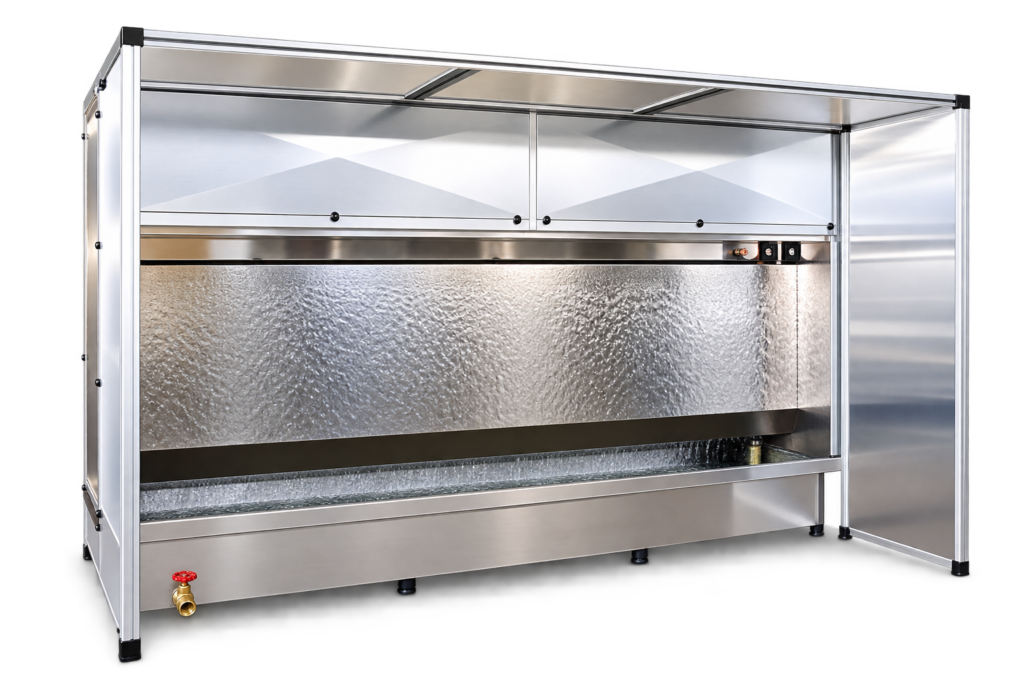
Water walls use an extraction fan to draw contaminated air from the workstation into a water-based collection system. Water spray helps capture dust and mist particles, with the collected waste forming a sludge that can be directed into the workshop’s water recycling system for treatment. Droplet separators then remove water droplets from the airflow before the extracted air is discharged outside through suitable ducting. Water walls can be used for wet grinding, polishing and hand-finishing applications. Their effectiveness depends on correct positioning, suitable containment, sufficient airflow and ducting arrangements, considering the workstation layout, operators and tasks being carried out.
Water wall LEV systems must be externally vented and should be designed and commissioned by a competent LEV specialist with experience in the stone industry and an understanding of respirable crystalline silica (RCS). We recommend specialists holding BOHS P604, or P603 as a minimum, subject to their competence for the work involved.
Once installed, LEV systems must undergo thorough examination and testing at least every 14 months, with test records retained for a minimum of five years. Commissioning benchmarks and relevant long-term exposure records should also be maintained.
At Stonegate, we supply Filter Projects wet water walls, available in 3 metre and 4 metre models to suit different stone fabrication workstations.
Both models are available with an optional canopy, alongside additional accessories such as air diffusers, customised ducting and suction arms, depending on installation requirements.
Choosing the right water wall depends on your workstation size, the tasks being carried out, operator positioning and the extraction requirements. A site-specific assessment is essential to ensure the equipment is suitable for its intended application.
Explore our wet water wall range or contact our team to discuss your requirements.
Water wall specifications
| Specification | 3m Water Wall (CA-30) | 4m Water Wall (CA-40) |
| Length | 3,140mm | 4,140mm |
| Width | 980mm | 980mm |
| Height | 2,435mm | 2,435mm |
| Weight | 425kg | 560kg |
| Power | 4.1kW | 5.9kW |
| Noise | 74dB | 74dB |
| Price (ex. VAT and carriage) | £9,400 | £11,350 |
| Optional canopy | £800 | £900 |
At Stonegate, we supply MaxVac Dust Blocker air scrubbers, designed to filter residual airborne dust in stone fabrication workshops. An internal fan draws contaminated air through a multi-stage filtration system, with pre-filters capturing larger particles and HEPA filters trapping finer particles, including respirable crystalline silica (RCS) dust.
Even with water suppression and local exhaust ventilation (LEV) in place, some airborne dust may remain in the workshop. Air scrubbers provide an additional layer of protection, filtering the surrounding air to help reduce airborne contamination.
However, air scrubbers are a supplementary solution and should never replace effective dust suppression or extraction at source. Their performance also depends on correct positioning, adequate airflow and regular filter maintenance.
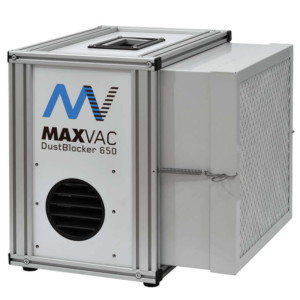
The MaxVac DustBlocker DB650 is a compact option, ideal for workshops where space is limited or more localised background filtration is needed. It features dual-voltage operation, adjustable airflow and a filter alarm.
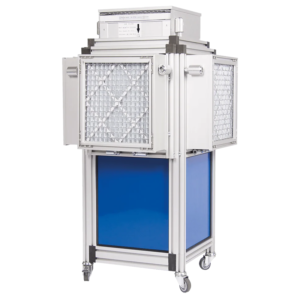
The MaxVac DustBlocker Pro 25 is designed for larger working environments requiring greater air filtration capacity.
When choosing an air scrubber, consider the volume of air requiring filtration, unit positioning and available power supply. Manufacturer-recommended room volumes should also be considered alongside your workshop layout, processes and existing dust-control measures to ensure the unit is suitable for your application.
Water walls and air scrubbers serve different purposes, but they can work together as part of a wider dust-control strategy. Water walls help capture contaminated air at suitable processing stations, while air scrubbers provide supplementary filtration for residual airborne dust.
Water walls vs air scrubbers
| Buyer question | Water walls | Air scrubbers |
| What do they control? | Contaminated air at suitable wet processing stations | Residual airborne dust |
| Where are they used? | At grinding, polishing and hand-finishing workstations | In the wider workshop |
| What affects selection? | Containment, airflow, positioning and ducting | Room volume, airflow, positioning and filtration |
| Can they work together? | Provide local extraction at suitable workstations | Complement extraction with additional airborne dust filtration |
For example, a workshop carrying out wet grinding and polishing may use a water wall as part of a properly designed LEV system, alongside an air scrubber to help reduce residual airborne dust elsewhere in the workshop.
Air scrubbers should never be used as a replacement for effective dust suppression or extraction at source. The right combination of equipment depends on your workshop layout, processes and existing dust-control measures.
Before investing in dust management equipment, consider the materials being processed, the tasks carried out and where dust and mist are generated. All stone dust must be appropriately controlled, regardless of silica content.
Your workshop layout, operator positioning and existing extraction systems should also be assessed, alongside these practical considerations:
Ultimately, equipment selection should be based on a site-specific risk assessment, with reference to current HSE guidance on controlling stone dust.
Not sure which dust control equipment is right for your workshop? Our team is here to help.
Tell us about your current processes and existing setup, including workshop dimensions, photographs and the tasks being carried out. With this information, we can provide product recommendations, quotations and introductions to specialist LEV consultants where required. We can also advise on additional protective measures, including respiratory protective equipment (RPE).
Take the next step towards a safer workshop. Contact our team on +44 (0)1482 620400 or email [email protected] to discuss water walls and air scrubbers for your workshop.