
Porcelain is becoming a more popular choice for kitchen worktops across the world as it’s durable, more budget-friendly than natural stones, and provides design flexibility. But what exactly is porcelain?
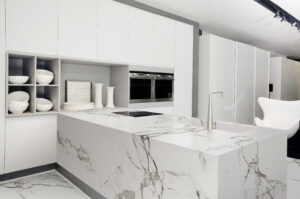
Porcelain, also known as ceramic, UCS or sintered stone, is a man-made material, designed to replicate the look of natural stone, such as granite or marble. It is engineered by combining a range of natural materials that are then formed into slabs, using a high-temperature manufacturing process called sintering. Sintering is a process that heats particles, in a furnace or an oven, below their melting point, causing the particles to merge. You’re then left with a solid, stronger and more durable piece of material.
Some of the most well-known and trusted porcelain surface manufacturers include Dekton, Neolith and Laminam.
Beneficial Properties of Porcelain
Now we know what porcelain is and how it’s made, let’s talk about its beneficial properties which make it such a popular choice for kitchen and bathroom surfaces.
Low Porosity
The sintering process used to make porcelain makes it a solid, dense composition. Because of this, porcelain is non-porous and non-absorbent, meaning that it doesn’t absorb water or spillages, and is highly resistant to stains, liquids and bacteria, making it a perfect option for busy household kitchens.
Design Variety
Porcelain is manufactured to give the look of natural stone, at a fraction of the cost. Because it is man-made from a mixture of natural materials, it can be produced in a wide variety of colours, patterns and textures. Once formed, porcelain can feature different designs, such as veining, printed on its surface using advanced printing technology – making each slab unique to the customer.
Durability and Heat Resistance
Porcelain is a durable, hard-wearing material that can withstand more demanding environments than natural stone. Its durability and dense composition make it reliable for high-traffic areas. It’s heat resistant, making it practical for kitchens where high temperatures are common, though protection from direct heat is still recommended. Porcelain is also UV resistant, helping to preserve its colour when exposed to sunlight, making it a considered choice for kitchens with natural light or outdoor spaces. Results may vary depending on placement and exposure.
Hygienic Surface
Because of it’s extremely low porosity and resistance to bacteria, moisture and stains, porcelain is considered one of the most hygienic surface materials available. These properties make it a perfect choice for kitchen installations, where spills, mess and germs are common. It can be easily wiped clean, promoting a cleaner, healthier environment for food preparation and daily use.
Low Maintenance
While natural stone surfaces will require sealing and regular attention, porcelain is a low maintenance alternative. This durable, non-porous surface resists common household stains and can be cleaned with basic household cleaners, so there’s no need for harsh chemicals. However, as with any high-quality surface, regular cleaning is important to preserve its appearance. For best results, we recommend using a cleaner designed specifically for porcelain surfaces, such as our Stone Gleam cleaner and polish.
Fabricating Porcelain
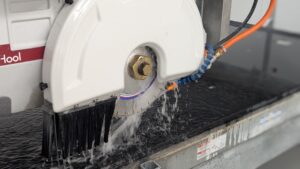
Although porcelain is in high demand when it comes to household surfaces, traditionally it has been perceived as difficult to fabricate. When subjected to blunt force from diamond tooling such as saw blades, porcelain can be more susceptible to chipping and surface damage. Despite this, porcelain can be just as straightforward to fabricate, providing you are using the right tools at the right parameters. It is also important to ensure you are using the correct cutting techniques and must-do practices to achieve a flawless finish, every time.
Decades of experience in the industry, combined with customer feedback, has enabled us to develop a Stonegate exclusive range of porcelain-specific tooling that makes fabricating easy. We have also worked directly with the world’s leading porcelain slab suppliers to better understand the composition of the product, and how that will affect the fabrication. Our offering includes high-performance porcelain saw blades, such as the next-generation Emperor Mk2, engineered to deliver flawless cuts time after time. For grinder applications, we offer options like the K Porcelain Blade and the KGS K835. When it comes to core holes and sink cut-outs, the BLU UCS range of core drills and routers provides clean, accurate results with minimal chipping.
Get in touch on +44 (0)1482 620400, or email [email protected] for further information. We also host regular training days in our Innovation Hub, where our experts can provide bespoke guidance on fabricating porcelain using our tooling.